
Quatermain's Journal
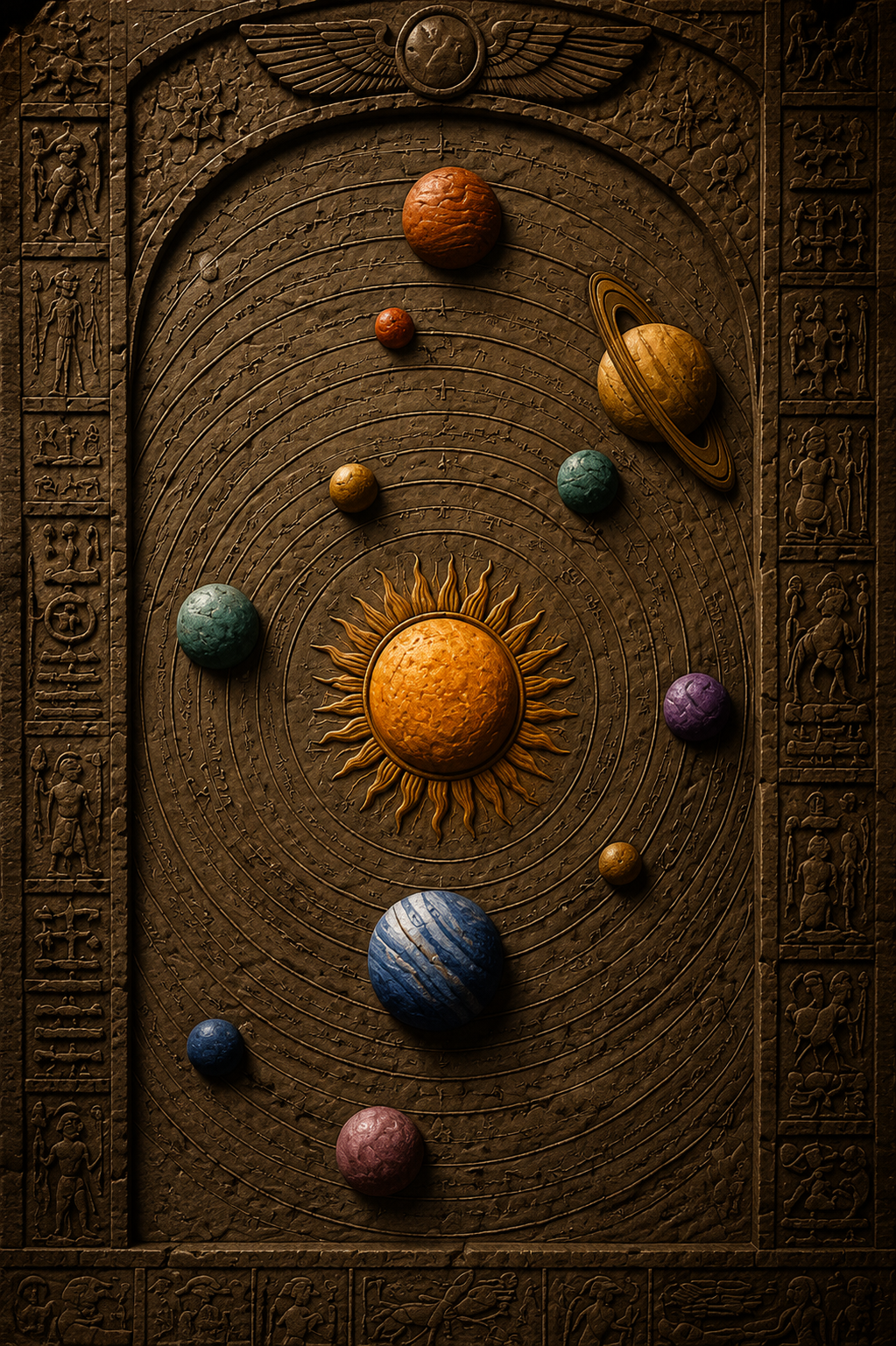
The mechanism now known as the Orrery of Ra is attributed to an unknown Alexandrian workshop during the second century before Christ. Its surviving inscriptions combine Egyptian solar imagery with mathematical markings more closely associated with the astronomers of the Hellenistic world.
At its centre rests Ra, represented not as a god in human form, but as the Sun itself. Around it, a series of coloured spheres travel upon engraved paths. When the concealed mechanism is turned, each sphere moves at a different rate according to its place within the celestial order.
The device appears to have been intended as more than decoration. Its graduated rings may have allowed an informed operator to demonstrate planetary cycles, anticipate important alignments and estimate the approach of eclipses and seasonal changes.
The Alexandrian Connection
Alexandria brought Egyptian priests, Greek mathematicians, navigators and engineers into contact with one another. It is entirely plausible that such a place could have produced a mechanical model of the heavens, particularly during an age that also gave rise to increasingly sophisticated astronomical instruments.
The proposed date of approximately 150 BCE remains uncertain. If correct, the Orrery would belong to the same broad tradition of mechanical astronomy later demonstrated by the Antikythera Mechanism.
Unlike a conventional astronomical instrument, however, the Orrery places the Sun at the centre. This recalls the heliocentric proposal of Aristarchus of Samos, whose disputed theory suggested that Earth and the other known planets travelled around the Sun.
The Outer Spheres
The greatest difficulty lies with the outermost spheres. Several appear to represent celestial bodies that should have been unknown to astronomers of the period.
Some researchers argue that these spheres were added during a later reconstruction. Others maintain that they represent symbolic worlds, wandering stars or stages in the soul's passage through the heavens.
A more troublesome possibility remains: that the original maker possessed observations inherited from a much earlier and presently unidentified source.
Quatermain Field Observation
Men are often willing to forgive the ancients for being clever, provided they were not clever too soon. The Orrery of Ra presents precisely that discomfort—a machine which appears to know more than its age should reasonably permit.
Archive Notes
Provisional Date: Circa 150 BCE
Attributed Origin: Alexandria, Ptolemaic Egypt
Classification: Mechanical Astronomical Model
Proposed Functions: Planetary demonstration, eclipse estimation, celestial alignment and seasonal calculation
Mechanism: Interconnected moving planetary spheres
Historical Status: Attribution and age remain disputed
Archive Status: Archive Only — physical reconstruction under development